When I started going freelance at the beginning of 2025, I needed a website quickly. I followed the Astro tutorial, found a community template that looked decent enough, and shipped it. The website featured a section about the servies I offer, a short vita section, a blog, and a contact from that people could use to get in touch with me. But it looked like a thousand other developer portfolios.
A Year of Incremental Improvements
Over the course of 2025 I kept improving it.
Some of that was fixing real bugs - a theming issue in markdown sections, a broken LinkedIn icon after a react-icons major version bump, some semantic HTML problems in the blog post markup.
Small things, but the kind that accumulate.
I also added things I care about from a maintenance perspective. Renovate for automated dependency updates, and a Playwright-based visual regression test suite running in Docker so those automated PRs don’t silently break the layout. Because what’s the point of automated updates if you’re not confident they didn’t break anything?
Later in the year I added real testimonials from people I’d worked with. And I kept publishing blog posts whenever I had some spare time. I also got some inbound leads via the contact form, and multiple people requesting my services said they did so because of my blog posts. This made the blog become the central piece of the webiste and slowly made me care more about how the reading experience actually felt.
By the end of 2025 the site worked, but it still felt generic. Time for something that actually looked like me.
Designing with Google Stitch
So I wanted to redesign my website and make it look a little less generic an more modern. The problem was: I’m really bad at designing. When I look at websites I can tell what I like and what I don’t like, but I can’t start with an empty canvas and design something nice from stratch. Then I’d heard about Google Stitch from a Fireship video, where it was called out to be an AI accelerated Figma killer. I gave it a try, feeding it some context about what I do and provided a link to my webiste.
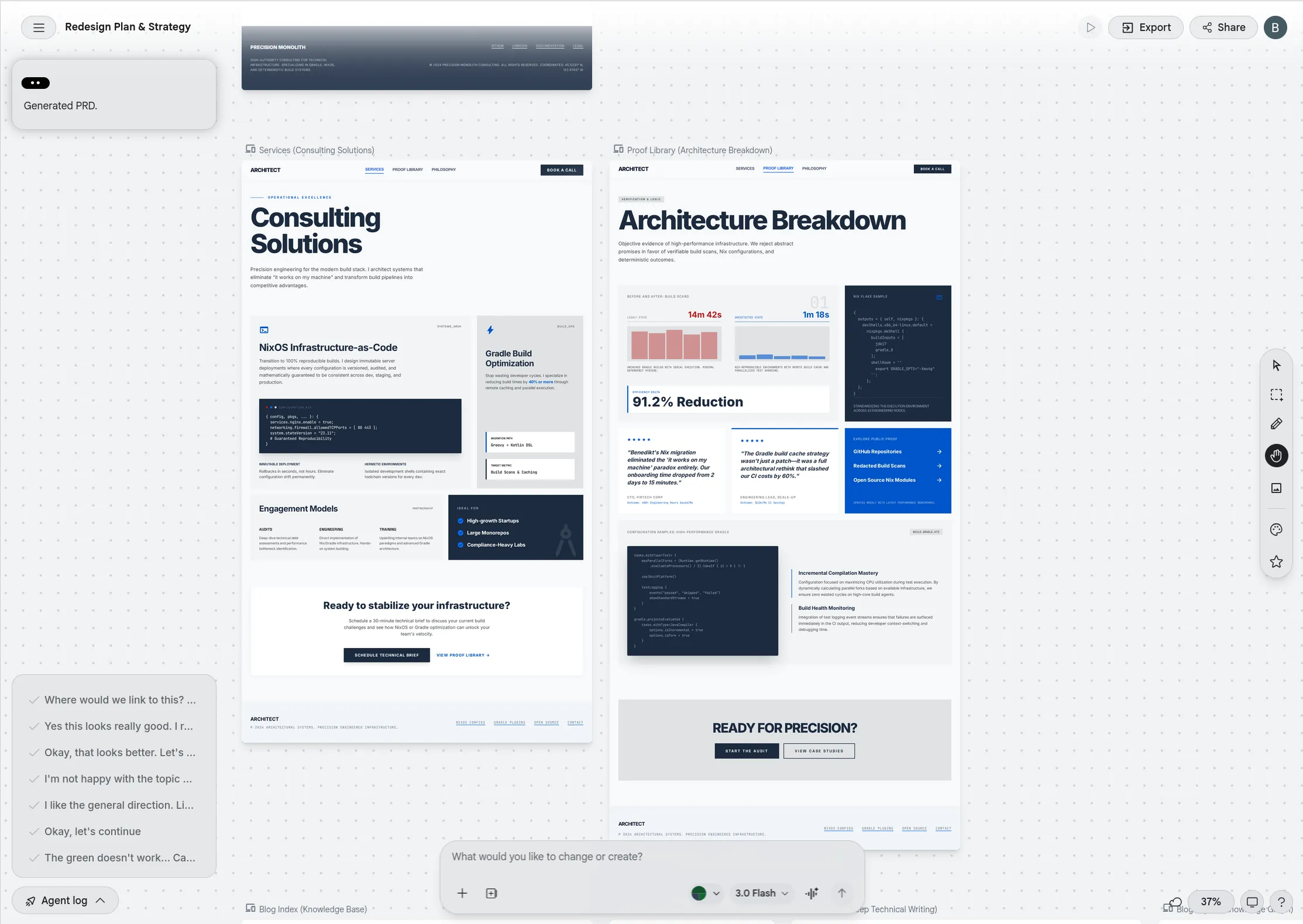
Google Stitch in action.
The results were mixed. I liked the initial blue-ish design, which is what you can now see in the final result. However, Stitch goes beyond colors and margins. It creates a design system that also includes what kind of content is presented and in which way. Instead of having a portfolio website, it proposed to create a “technical authority hub”. It added statements such as “40% average build time reduction - achieved through remote cache optimization and and dependency graph pruning.” A lot of it sounded like LinkedIn speak, but I still liked the visual appearance.
Iterating With Claude
From there, I exported the design system and started building in Astro with Claude Code. This is where the actual work happened - about two days of back and forth. A few decisions that came out of that process:
Simplified Services Portfolio. I went from four service offerings down to two: Gradle and NixOS. The other two (Engineering Growth, and Developer Productivity Engineering) and never been requested by anybody. Arguably both of them were too vague and people probably don’t search for this kind of consulting.
The blog as the central piece. I renamed it Reproducible Thoughts - a name that fits the intersection of Gradle, NixOS, and reproducibility that most of my writing lives in. Post pages now open with a dark journal-style header that gives the whole thing a more deliberate publication feel. I also revamped the blog listing page and added a listing by topic. Last but not least the three most recent blog posts are now listed on the home page.
OG images automation. The old site used a different hero image per blog post - a mix of stock photos and AI-generated images. Most of them were fine in isolation, but together they made the blog listing look incoherent. Every post had a different color palette, mood, and style. I replaced the whole approach with generated OG images using Satori: every post gets the same branded dark template with the title, topics, date, and the Reproducible Thoughts wordmark. Another piece of my website automated, so I don’t need to think about it anymore.
A proper vita page. The old site had a thin CV section. The new vita page has a full work history timeline with company descriptions and personal extended reflections on each role. I also added my latest career step, which is testlens.app.
An open source page. A significant part of what I do lives in open source - GradleX, nixpkgs contributions, Apache Software Foundation membership. This wasn’t reflected at all in the old design. Now it has its own page.
What I’d Do Differently
Stitch is good for creating a design system if you’re not good at designing like me. The direction of the content it created didn’t feel like a good fit for me so I just used the visuals in the end. For that reason, when designing a website for a new product, I would still recommend hiring a professional.
The two days with Claude were surprisingly productive. I’d estimate the same work would have taken me a week alone - mostly because the feedback loop of “does this look right?” → “try this” → “still not quite” is fast when the other side can both reason about the design and write the code.
The site still isn’t perfect but it’s a gradual improvement over what I before. Enough for year 2 of my self-employment. Hope you like it!

Benedikt Ritter
Gradle & NixOS Consultant
Developer productivity consultant with five years at Gradle Inc. building Develocity, and co-founder of TestLens. Apache Software Foundation member and founder of GradleX. I help engineering teams ship faster through better Gradle build tooling and reproducible NixOS infrastructure.